


All products are selected by our Sharp Survivalist editors. If you buy something through our links as an Amazon Associate we earn from qualifying purchases.
Surviving in the wilderness does not depend on having the best gear. It depends on knowing what to do when things go wrong. Skills decay slowly; batteries die fast. Whether you are a hiker, hunter, backpacker, or prepper building your emergency preparedness plan, these are the foundational survival competencies that must be practiced — not just read about.
The Survival Priority Order
Before learning individual skills, understanding survival priorities prevents critical decision-making errors in the field. The widely accepted order is:
- Protection (from immediate threats and exposure)
- Rescue signaling
- Water
- Fire
- Food
Most untrained people reverse this, spending energy on food when dehydration or hypothermia is the actual threat. The human body can survive roughly 3 weeks without food, 3 days without water, and sometimes fewer than 3 hours in cold, wet conditions without shelter. Correct prioritization is a survival skill in itself.
1. Shelter Building
Exposure kills faster than almost any other wilderness threat. Hypothermia can set in at temperatures well above freezing when wind and moisture are combined — a condition known as the “hypothermia triangle” (cold, wet, wind).
Core shelter skills to learn:
- Debris hut construction: A low-profile, insulating shelter built from forest debris (sticks, leaves, bark). Effective in temperate forests and requires no tools.
- Lean-to: A quick, wind-blocking shelter using a ridgepole and angled branches. Less insulating than a debris hut but faster to construct.
- Tarp rigging: If carrying a tarp or emergency bivy, knowing five to six essential rigging configurations covers most weather conditions.
Key principle: insulation comes from air pockets, not material thickness. Two inches of packed leaves traps more heat than a thin synthetic blanket.
2. Fire Starting
Fire serves five survival functions: warmth, water purification, cooking, signaling, and psychological morale. Learning multiple fire-starting methods is essential because no single method works in every condition.
Methods every survivalist should master:
- Ferro rod and steel: The most reliable all-weather method. Works when wet. Produces a shower of hot sparks (up to 3,000°F) that ignite dry tinder.
- Lighter and waterproof matches: Basic but effective. Always carry as a backup.
- Bow drill: A primitive friction fire method using a wooden spindle, fireboard, and bow assembly. Takes practice but requires zero manufactured tools. Essential knowledge if all other methods fail.
Tinder preparation is equally important. Fire starting fails most often not from ignition but from inadequate tinder. Learn to identify and prepare natural tinder: dry grass, birch bark, fatwood shavings, cattail fluff, and dry leaf powder. Practice building a tinder bundle before you need one.
3. Water Sourcing and Purification
Dehydration impairs judgment before any physical symptoms become obvious. In a survival situation, impaired judgment leads to poor decisions that compound the problem.
Finding water in the wild:
- Follow terrain downhill — water collects at the base of valleys and in drainages
- Look for animal trails converging; they often lead to water sources
- Morning dew collected from vegetation can supplement water intake
- In dry terrain, dig in dry riverbeds at the outside of bends where subsurface water collects
Purification methods, in order of reliability:
- Boiling: Kills all biological threats (bacteria, viruses, protozoa). Requires fire and a container. Bring water to a rolling boil for at least 1 minute (3 minutes at altitude above 6,500 feet).
- Chemical treatment: Iodine tablets and chlorine dioxide tablets are lightweight and effective. Chlorine dioxide treats a broader spectrum of pathogens including Cryptosporidium.
- Filtration: Pump filters and squeeze filters remove bacteria and protozoa but not viruses (unless the filter is rated for viral removal).
- Improvised filtration: A field-expedient filter using sand, gravel, and charcoal removes sediment and improves taste but does not purify biologically. Always follow with boiling.
4. Navigation Without Electronics
GPS devices and smartphones fail — batteries die, screens break, signals disappear in deep canyons. Map and compass navigation is a non-negotiable wilderness survival skill.
Core navigation skills:
- Reading a topographic map: Understand contour lines, elevation changes, water features, and terrain identification. A topo map tells you what the land looks like before you see it.
- Compass use: Learn to take a bearing, follow a bearing, and triangulate position using two known landmarks.
- Natural navigation: Sun tracking (rises in the east, sets in the west), star navigation (Polaris indicates true north in the Northern Hemisphere), and shadow tip method for determining cardinal directions.
- Dead reckoning: Estimating current position based on a known starting point, direction of travel, speed, and elapsed time.
Practice navigation in familiar terrain before relying on it in the backcountry.
5. Signaling for Rescue
The fastest way out of a survival situation is being found. Most rescue scenarios resolve within 72 hours when survivors signal effectively.
Signaling methods by effectiveness:
- Signal mirror: Can reflect sunlight to aircraft and rescuers up to 10 miles away. The single most effective signaling tool in bright conditions.
- Whistle: Three blasts is the universal distress signal. Carries much farther than a voice and requires little energy.
- Smoke signals: Large fires with green vegetation added produce white smoke visible for miles. Build signal fires in clearings for maximum visibility.
- Ground-to-air signals: Stomp or lay out large symbols in open ground — V (need assistance), X (need medical help), → (traveling in this direction). Make them at least 10 feet across to be visible from aircraft.
6. Wilderness First Aid Fundamentals
Knowing how to manage injuries until evacuation is possible prevents a minor wound from becoming life-threatening.
Skills that matter most in the backcountry:
- Wound cleaning and closure: Irrigation with clean water removes debris. Closure strips hold wound edges together to reduce infection risk.
- Splinting fractures: Immobilize the joint above and below a suspected fracture using available materials (sticks, trekking poles, clothing).
- Treating hypothermia: Remove wet clothing, insulate from ground, add dry insulation, apply heat to core (armpits, groin, neck), and get warm fluids into the patient if conscious.
- Managing dehydration: Recognize early signs (decreased urination, dark urine, headache) and correct before cognitive function is impaired.
7. Food Procurement
Food is the lowest survival priority but relevant in extended situations. Focus on skills with the best return on energy investment.
- Trapping: Simple snares (wire loop snares on game trails) produce food passively while you perform other tasks. Learn legal regulations before practice.
- Fishing: A few feet of line and a small hook weigh almost nothing and can provide significant caloric return near water.
- Plant identification: Learn a small number of universally edible plants in your region (dandelion, cattail, pine needles for vitamin C tea) rather than attempting broad foraging without expert guidance.
Frequently Asked Questions
What is the most important wilderness survival skill? Shelter building is widely considered the most critical wilderness survival skill because exposure and hypothermia kill faster than dehydration or starvation. Building an effective emergency shelter from natural materials requires no tools and can be the difference between surviving a night in cold rain and not.
How long does it take to learn basic wilderness survival skills? Core competencies — shelter building, fire starting with a ferro rod, water sourcing, and basic navigation — can be learned to a functional level in one to two weekends of dedicated practice. Primitive skills like bow drill fire and advanced navigation take significantly longer to master reliably.
What are the survival rule of threes? The rule of threes is a memory aid for survival priorities: you can survive roughly 3 minutes without air or in icy water, 3 hours without shelter in harsh weather, 3 days without water, and 3 weeks without food. These are approximations, but they correctly establish the order in which to address threats.
Is it safe to drink water from a stream in the wild? No. Waterborne pathogens including Giardia, Cryptosporidium, E. coli, and various bacteria are present in most natural water sources, including remote mountain streams. Always purify water by boiling, chemical treatment, or a rated filter before drinking.
What navigation tools should I carry in the wilderness? Carry a detailed topographic map of your area and a baseplate compass as a minimum. A GPS device is a useful supplement but should not replace map and compass as your primary navigation system. Know how to use both before you go.
Can primitive fire-starting methods actually work in wet conditions? Bow drill and other friction fire methods are significantly harder in wet conditions because the friction required generates moisture that inhibits combustion. Carry a ferro rod and lighter as primary methods. Bow drill is a genuine survival backup that works when materials can be dried, but it requires practiced technique to succeed under field conditions.
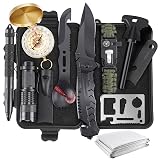
- 【13 in 1Survival Kits】The 13 in 1survival kits contains 13 essential and practical tactical gears and survival tools to meet your different needs in outdoor activities like camping hiking backpacking fishing, etc. The kit includes: survival bracelet, tactical pen, compass, tactical flashlight, flint stone & scraper, multifunctional card, 8 in 1multi-use spoon & fork, fake shrimp bait. With these professional survival gear and equipment you can enjoy a safe and easy outdoor time.
- 【Cool Gifts for Men Who Have Everything】The military grade survival kits are cool gifts for men who have everything, great birthday Christmas Valentine’s Day Anniversary Day gift ideas for dad husband boyfriend teen boys, and scouts who love outdoor adventures.
- 【High Quality Survival Kits】This is a high quality survival tool set. The tool box is made of military grade ABS material. And all the survival gears in it are made of high-quality, long lasting materials, providing excellent safety and durability. This survival kit is a perfect and reliable companion to be prepared for any emergencies. It’s an unique and thoughtful gift for dad mum family friends from daughter son.