


All products are selected by our Sharp Survivalist editors. If you buy something through our links as an Amazon Associate we earn from qualifying purchases.
When you’re deep in the backcountry and weather turns savage, your poncho is the difference between a manageable situation and a life-threatening emergency. Unlike a standard rain jacket, a survival poncho serves multiple functions — shelter, waterproof layer, signaling device, and ground cover — which is why choosing the right one deserves serious consideration before any wilderness trip.
What Makes a Survival Poncho Different From a Rain Poncho
A regular rain poncho keeps you dry on a summer hike. A wilderness survival poncho is engineered to keep you alive.
The distinction comes down to material durability, multifunctionality, and weather resistance under sustained stress. Survival ponchos are designed to:
- Withstand wind speeds exceeding 50 mph
- Provide emergency shelter when rigged as a lean-to or debris tent
- Retain body heat through reflective or insulated lining
- Pack down small enough to fit in a go-bag or survival kit
If a poncho can’t perform all these roles under pressure, it doesn’t belong in a survival kit.
Key Features to Look For in a Wilderness Survival Poncho
Material and Waterproofing
The best survival ponchos use reinforced ripstop nylon, Mylar, or military-grade polyester with sealed seams. Mylar emergency ponchos are lightweight and reflective — excellent for heat retention and signaling — but they tear easily and are single-use. For multi-day survival scenarios, a 5 oz to 8 oz ripstop nylon poncho with a 5,000mm+ hydrostatic head rating is the gold standard.
Avoid ponchos with taped (rather than heat-welded) seams. Taped seams degrade faster and fail under prolonged rain exposure.
Size and Coverage
In a survival situation, coverage beats style. Look for a poncho that extends below the knee and has extra width (at least 60 inches across) to cover a loaded backpack. Many survival ponchos include a built-in hood with a drawcord — essential for reducing heat loss through the head.
A generous cut also allows the poncho to double as a ground cloth or improvised bivy. This dual-use capability is a critical survival advantage.
Grommets and Attachment Points
Reinforced brass or stainless steel grommets along the hem allow you to stake the poncho as a tarp shelter or rig a ridgeline with paracord. Four corner grommets are the minimum; eight or more give you significantly more shelter configuration options. Military ponchos — like the US Army-issue poncho — include snap closures that allow two ponchos to join and form a tent.
Weight vs. Durability Trade-Off
Ultralight backpackers often carry a 2–3 oz emergency Mylar poncho as a backup, while their primary rain layer handles daily weather. Survivalists and preppers typically prefer a 10–14 oz military ripstop poncho that can take a beating over multiple days without failing.
For true wilderness survival readiness, carry both: a durable primary poncho and a compact Mylar backup for emergency signaling and extra insulation.
How to Use a Survival Poncho as Emergency Shelter
Knowing how to deploy your poncho as shelter is as important as owning one. Here are the most effective field configurations:
A-Frame Shelter: Run a ridgeline between two trees at chest height. Drape the poncho over it, stake the corners to the ground. Provides solid rain and wind protection for one to two people.
Lean-To: Tie the hood end of the poncho high on a tree or pole, stake the opposite end low to the ground at a 45-degree angle. Works best in light rain with a backing windbreak.
Debris Tent Overlay: Lay the poncho over a framework of sticks and pile debris (leaves, pine boughs) on top for insulation. This configuration can maintain survivable temperatures in near-freezing conditions.
Ground Sheet: Spread the poncho flat to create a moisture barrier between you and the ground. Groundwater and conduction cooling are underrated threats to survival.
Survival Poncho Vs. Emergency Bivy: Which Should You Carry?
Both have a place in a survival kit, but they serve different primary functions.
| Feature | Survival Poncho | Emergency Bivy |
|---|---|---|
| Rain protection | Excellent | Moderate |
| Heat retention | Moderate | Excellent |
| Shelter building | Yes | No |
| Signaling (Mylar) | Yes | Yes |
| Pack size | Small–Medium | Ultra-compact |
For wilderness survival, the poncho wins on versatility. It handles rain, rigging, signaling, and ground cover. A bivy excels at overnight heat retention but can’t replace shelter-building capability.
Experienced wilderness guides typically recommend carrying both in a full survival kit, where the bivy fits inside the poncho for a two-layer thermal and waterproof system.
Military Poncho vs. Civilian Survival Poncho
The US military-issue poncho (GI poncho) remains a benchmark in survival gear for several reasons: ripstop nylon construction, olive drab/camo coloring, reinforced snap system for joining two units, and eight hem grommets. It weighs approximately 14 oz and packs to roughly the size of a large paperback.
Civilian alternatives have closed the gap significantly. Modern survival ponchos from outdoor gear manufacturers often improve on the military design with lighter ripstop fabrics, improved waterproofing treatments (DWR coatings), and brighter blaze orange interiors for emergency signaling — a feature the military design lacks by necessity.
For civilian wilderness survival use, a poncho that combines military-grade grommet placement with a high-visibility interior provides the best of both worlds.
Care and Maintenance for Long-Term Reliability
A survival poncho only works if it’s maintained properly:
- Re-apply DWR treatment annually or after heavy use. Wash-in DWR products restore water repellency to worn fabric.
- Store loosely rolled, not folded on the same creases repeatedly — this weakens fabric and seams over time.
- Inspect seams and grommets before every trip. A failed grommet in the field renders the poncho useless as a shelter.
- Dry completely before storage to prevent mildew, which degrades waterproof coatings and weakens nylon fibers.
Frequently Asked Questions
What is the best material for a wilderness survival poncho? Reinforced ripstop nylon with a DWR coating and sealed seams is the most durable option for multi-day wilderness use. Mylar is best reserved for emergency backup ponchos due to its fragility.
Can a survival poncho replace a tent? In a pinch, yes. A properly rigged poncho with grommets and paracord provides effective rain and wind protection. However, it offers no insulation on its own — combine it with an emergency bivy or natural debris for warmth.
How heavy should a survival poncho be? For serious wilderness survival use, 8–14 oz strikes the right balance between durability and packability. Anything lighter risks tearing under sustained wind or extended use.
What is the difference between a rain poncho and a survival poncho? Rain ponchos prioritize lightweight weather protection. Survival ponchos add multi-functional features: grommets for shelter rigging, reflective Mylar lining for signaling and heat retention, and reinforced construction that holds up under wilderness conditions.
Should a survival poncho have a hood? Yes, without exception. An adjustable, drawcord hood is essential for heat retention — up to 40% of body heat is lost through the head. A hood also keeps rain off the face, improving visibility and decision-making in storm conditions.
How do I use a poncho as a water collector? Rig the poncho in a bowl or funnel shape using the grommets and cordage, angled toward a collection point. During rain, this method can collect several liters of water per hour — a critical survival capability.
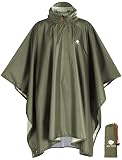
- polyester
- Imported
- Waterproof & Sturdy Material: Made of 210T ripstop polyester with TPU coating, this reusable rain poncho offers PU 8000MM waterproof protection. Seam sealing/taping helps block water through seams. The drawstring hood and side hook-and-loop fasteners adjust for a secure fit, protecting your head and face in heavy rain