

All products are selected by our Sharp Survivalist editors. If you buy something through our links as an Amazon Associate we earn from qualifying purchases.
Whether you’re a seasoned backcountry hiker or a weekend camper, having the best wilderness survival kit could mean the difference between life and death. Emergency situations in the wild — from unexpected storms to getting lost off-trail — happen fast. A well-assembled survival kit ensures you’re prepared for the unexpected.
What Is a Wilderness Survival Kit?
A wilderness survival kit is a curated collection of tools, gear, and supplies designed to help you survive emergency situations in remote or outdoor environments. Unlike a standard camping kit, a survival kit focuses on core priorities: shelter, fire, water, signaling, navigation, and first aid.
The best kits are compact, lightweight, and built around the Rule of Threes — humans can survive:
- 3 minutes without air or in icy water
- 3 hours without shelter in harsh conditions
- 3 days without water
- 3 weeks without food
Every item in your kit should address one or more of these survival pillars.
Essential Components of the Best Wilderness Survival Kit
1. Shelter and Warmth
Hypothermia is one of the leading causes of death in the wilderness. Your kit must include reliable shelter options.
Must-have items:
- Emergency bivvy or space blanket — Reflects up to 90% of body heat. Mylar emergency blankets are ultralight and pack down to the size of a deck of cards.
- Tarp or emergency tube tent — Provides overhead protection from rain, wind, and snow.
- Fire starter kit — Include a ferrocerium rod (works wet), waterproof matches, and a butane lighter as backup.
Look for a windproof, waterproof fire starter rated for extreme temperatures, especially if you’re venturing into alpine or subarctic terrain.
2. Water Procurement and Purification
Dehydration accelerates exhaustion and impairs judgment. Your survival kit needs multiple water-sourcing methods.
Essential water gear:
- Portable water filter (e.g., hollow fiber membrane filter) — Removes bacteria and protozoa instantly.
- Water purification tablets — Lightweight backup; effective against viruses where filters may not be.
- Collapsible water container — Allows you to carry and transport water from a source.
- Metal cup or titanium pot — Enables boiling as a third purification method.
Experts recommend the layered approach: filter first, then purify chemically or by boiling for maximum safety in high-risk water sources.
3. Navigation Tools
Don’t rely solely on your phone GPS — batteries die and signals disappear in deep wilderness.
Navigation essentials:
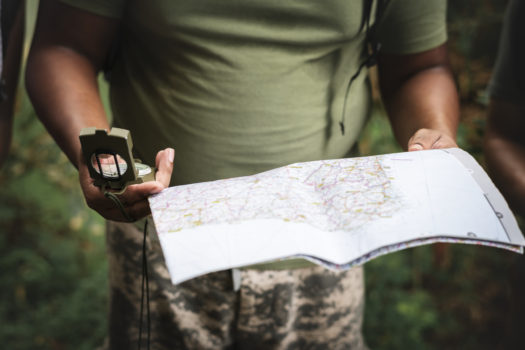
- Baseplate compass — Learn to use it before you need it. A quality liquid-filled compass is accurate and durable.
- Topographic map of your area (waterproofed or laminated)
- Signal mirror — Can be seen up to 10 miles away by aircraft on a clear day.
Pairing analog navigation tools with digital backups (a GPS device or offline maps) creates the most resilient system.
4. First Aid Supplies
Injuries in the backcountry can’t wait for emergency services. A compact, wilderness-specific first aid kit should include:
- Wound closure strips and butterfly bandages
- Sterile gauze pads and medical tape
- SAM splint for fracture immobilization
- Blister treatment (moleskin or hydrocolloid bandages)
- Antihistamines and pain relievers
- Tweezers for tick and splinter removal
- Trauma shears
- Elastic bandage wrap
Wilderness first aid training significantly improves how effectively you use these tools. Consider a Wilderness First Responder (WFR) or WAFA course if you spend extended time in remote areas.
5. Signaling and Communication
Getting rescued requires being found. Never leave without signaling tools.
- Personal Locator Beacon (PLB) or satellite communicator — Sends an SOS with GPS coordinates to rescue services, even without cell service.
- Whistle — A loud pealess whistle (Fox 40 or Storm) carries farther than your voice and uses no energy.
- Signal mirror — Works in tandem with your navigation kit.
- Brightly colored gear or flagging tape — Makes you visible from the air.
A PLB is a non-negotiable item for solo hikers or anyone venturing more than a day’s walk from the trailhead.
6. Multi-Tool and Cutting Tools
A quality knife or multi-tool handles dozens of survival tasks — from building a shelter to preparing food.
- Fixed-blade knife — More reliable than folding knives under heavy use. Look for a full-tang design in stainless or high-carbon steel.
- Multi-tool — Pliers, wire cutters, file, and screwdriver in one compact package.
- Paracord (550 lb) — 50–100 feet enables shelter rigging, gear repair, and improvised equipment.
7. Food and Energy
While food is lowest on the survival priority list, calorie-dense emergency rations improve stamina, decision-making, and morale.
- Emergency food bars (2,400–3,600 calorie ration)
- Fishing kit (hooks, line, small lures)
- Snare wire
How to Choose the Best Wilderness Survival Kit
When evaluating a kit — prebuilt or DIY — apply these criteria:
Weight and packability: A kit you leave behind because it’s too heavy is useless. Aim for under 2 lbs for a day kit, under 5 lbs for extended backcountry.
Redundancy: Every critical function (fire, water, signaling) should have at least two methods.
Durability: Components should withstand wet, cold, and rough handling. Look for military-grade or field-tested materials.
Customization: No single kit fits every environment. A desert survival kit differs from an arctic one. Build or adapt your kit to match your specific terrain and trip duration.
Practice before you go: The best gear fails in the hands of someone who’s never used it. Practice starting fires with your ferrocerium rod, using your compass, and operating your PLB before your trip.
Frequently Asked Questions
What should be in a basic wilderness survival kit? A basic kit includes fire-starting tools, a water filter and purification tablets, an emergency shelter (space blanket or bivy), a compass and map, a knife or multi-tool, a whistle, a first aid kit, and a signaling device like a PLB or signal mirror.
How big should a wilderness survival kit be? For day hikes, a compact kit fitting in a small pouch (under 1–2 lbs) is sufficient. For multi-day backcountry trips, a more comprehensive kit weighing 3–5 lbs is appropriate.
Is a prebuilt survival kit good enough? Prebuilt kits offer convenience but often include low-quality items. Use them as a starting base, then upgrade key components — particularly the fire starter, water filter, and signaling device — with higher-quality gear.
What’s the most important item in a wilderness survival kit? Shelter-related gear — specifically fire-starting tools and an emergency bivy — is consistently prioritized by survival experts. Hypothermia kills faster than dehydration or starvation in most environments.
Do I need a PLB for day hikes? For remote or solo day hikes where cell service is unreliable, a PLB or satellite communicator is strongly recommended. Emergencies don’t schedule themselves around trip length.
How often should I replace items in my survival kit? Inspect your kit before every trip. Replace expired medications and water purification tablets annually. Check battery levels in electronic devices. Rotate food rations per their expiration dates.

- [Preparedness for the Unknown]: While no one can predict when or how severe a disaster or unexpected event will be, our 262pcs survival kit helps your family stay prepared during the critical first 72 hours. Designed for family use, it was developed in collaboration with survival experts, outdoor professionals, special forces operators, and mountain guides. Whether you’re preparing for earthquakes, tornadoes, wildfires, or hurricanes, our survival kit provides peace of mind.
- [Comprehensive Emergency Supply Kit]: The included emergency supplies are stored in a bright red pouch, containing tweezers, scissors and pins, non-woven pad, triangular cotton cloth, cotton swabs, cotton balls, a generous supply of adhesive strips etc., meeting your general emergency and outdoor needs. It also includes an emergency information card to record your basic information, helping others quickly access important information when needed.
- [Safety Companion for Journey]: Our emergency kit includes many survival gear and supplies to ensure access to food, water, warmth, and light in a crisis. The fishing kit and multi-usage spoon help you catch and prepare food, while the collapsible water container bag helps store water. Fire starter and stick make it easy to build a fire. A flashlight, camping lamp, and glow sticks provide up to 72 hours of lighting, crucial for signaling for help and safe navigation.