


All products are selected by our Sharp Survivalist editors. If you buy something through our links as an Amazon Associate we earn from qualifying purchases.
Why Camping Knots Are a Core Wilderness Survival Skill
Knowing how to tie the right knot in the right situation can be the difference between a secure shelter and a collapsed one, a rescued hiker and a stranded one. Camping knots are not just a bushcraft tradition — they are practical, life-saving tools used by search and rescue teams, military personnel, and outdoor survivalists worldwide.
Whether you are setting up a tarp shelter, securing a bear hang, rappelling a cliff face, or building a splint, the correct knot ensures your gear holds under pressure. This guide covers the most critical survival knots, how to tie them, and exactly when to use each one in the field.
The 8 Essential Camping Knots Every Survivalist Must Know
1. Bowline Knot — The Rescue Loop
Best for: Rescue operations, securing a fixed loop around an anchor, attaching a rope to a tree
The bowline (pronounced “BOH-lin”) creates a fixed, non-slip loop that will not tighten under load — making it ideal for rescue scenarios where a loop must go around a person’s body. It is one of the oldest and most trusted knots in wilderness survival.
How to tie it:
- Form a small loop (the “rabbit hole”) in the standing line.
- Pass the working end up through the loop.
- Wrap the end around the standing line.
- Pass the working end back down through the small loop.
- Pull tight.
Memory aid: The rabbit comes out of the hole, runs around the tree, and goes back down the hole.
2. Clove Hitch — The Quick Camp Anchor
Best for: Anchoring a rope to a post or tree, starting lashings, adjustable tension
The clove hitch is fast to tie, easy to adjust, and works on round objects like tent poles and tree branches. It is the go-to knot for setting up camp quickly and forms the foundation of many lashing techniques used in shelter building.
How to tie it:
- Pass the rope over the post and cross it over itself.
- Pass the rope over the post a second time.
- Feed the working end under the second wrap before pulling tight.
3. Taut-Line Hitch — The Adjustable Guy Line Knot
Best for: Tent guy lines, tarp rigging, any situation requiring adjustable tension
The taut-line hitch slides freely along the rope when loose but grips firmly under tension. It is the standard knot for adjusting tent guy lines and is widely taught in wilderness survival courses because of its versatility in dynamic outdoor conditions.
How to tie it:
- Pass the rope around an anchor and bring the working end alongside the standing line.
- Coil the working end twice around the standing line inside the loop.
- Make one additional coil on the outside of the previous coils.
- Pull tight and slide to adjust tension.
4. Square Knot — The Binding Knot
Best for: Joining two ropes of equal diameter, securing bandages, bundling gear
The square knot joins two rope ends cleanly. In a survival context, it is commonly used for binding wounds with cloth strips or securing a bundle of firewood. It should never be used as a primary load-bearing knot in climbing or rescue situations, as it can capsize under uneven pressure.
How to tie it: Right over left and under, then left over right and under. Both loops should sit flat and parallel.
5. Sheet Bend — The Best Knot for Joining Different Ropes
Best for: Joining two ropes of unequal thickness or material
When survival requires improvising with whatever cordage is available — paracord, shoelaces, natural fibers — ropes will rarely match in size. The sheet bend securely joins ropes of different diameters and is significantly more reliable than a square knot in this scenario.
How to tie it:
- Form a bight in the thicker rope.
- Pass the thinner rope through the bight from beneath.
- Wrap the thinner rope around both tails of the bight.
- Tuck the thinner rope under its own standing part and pull tight.
6. Figure-Eight Knot — The Stopper and Climbing Knot
Best for: Preventing rope from slipping through hardware, rock climbing anchors, rappelling
The figure-eight is the standard stopper knot in technical outdoor activities. It is easy to inspect visually — critical when a guide or partner must verify a knot quickly in high-stakes scenarios. A figure-eight follow-through is the primary harness attachment knot in rock climbing.
7. Prusik Knot — The Ascending Hitch
Best for: Ascending a rope, crevasse rescue, adding a friction brake to a rappel
The prusik creates a friction hitch on a larger rope using a loop of thinner cord. It grips under load but slides freely when weight is removed — making it invaluable for self-rescue in mountaineering and glacier travel.
8. Timber Hitch — The Log-Moving and Lashing Knot
Best for: Dragging logs, starting diagonal lashings, building primitive shelters
The timber hitch wraps around a log and tightens under tension, making it ideal for hauling lumber for shelter construction. It forms the first step of a diagonal lashing when building a debris hut or lean-to.
Knot Maintenance and Rope Care in the Field
A knot is only as reliable as the rope it is tied in. In wilderness survival situations, inspect cordage for fraying, UV damage, and moisture saturation before trusting it with body weight or structural loads. Natural fiber ropes (jute, hemp, manila) lose significant strength when wet. Synthetic ropes such as nylon and polyester maintain better integrity across wet and dry conditions.
After heavy use, untie knots immediately. Leaving knots under tension for extended periods causes permanent deformation in synthetic ropes, reducing their strength by up to 50%.
Frequently Asked Questions
What is the strongest camping knot for load bearing? The figure-eight follow-through retains approximately 80% of a rope’s rated strength, making it one of the strongest knots for load-bearing applications. The bowline retains around 70–75% of rope strength and is preferred in rescue scenarios for its quick-release capability.
What knot should beginners learn first? The bowline and clove hitch are the two highest-priority knots for beginners. Together they cover shelter rigging, anchoring, and rescue scenarios — the three most common knot applications in wilderness survival.
How does paracord affect knot performance? Paracord (550 cord) is the preferred survival cordage because its nylon sheath and inner strands maintain strength when wet, resist UV degradation, and accept most standard knots without excessive slippage. Its 550-pound breaking strength covers the majority of camping and survival tasks.
What is the difference between a hitch and a knot? A knot is tied in the rope itself. A hitch attaches a rope to an object, such as a post, ring, or another rope. In wilderness survival, hitches such as the clove hitch and taut-line hitch are used for anchoring and tensioning, while knots such as the figure-eight function as stoppers or connectors.
Can camping knots be used for medical emergencies? Yes. Square knots and reef knots are used to secure improvised bandages and splints. The bowline can create a chest harness or improvised stretcher attachment point. Knowing which knot to deploy in a medical scenario is part of comprehensive wilderness first aid training.
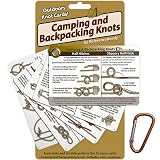
- EASY-TO-FOLLOW KNOT ILLUSTRATIONS: Clear, color-coded diagrams walk you through each knot step-by-step with plain-language descriptions and real-world usage tips, turning this compact pocket knots book into a confidence-boosting trail coach for campers who want skills they can actually use outdoors.
- JUST THE KNOTS THAT MATTER: The 22 knots were selected by knot pros for camping and backpacking scenarios encountered by campers, day hikers, thru-hikers, backpackers, scouts, preppers, and wilderness survivalists who care about weight. Why carry a knot book full of stuff you don’t need?
- INCLUDES MINI CARABINER: Comes with a small carabiner for clipping your cards to your pack, bug-out bag, or bushcraft gear. Use it to keep them close at hand and your backpacking essential knots will always be at the ready.