

All products are selected by our Sharp Survivalist editors. If you buy something through our links as an Amazon Associate we earn from qualifying purchases.
A survival knife is one of the few pieces of gear that earns its place in the wild across every task — from processing firewood to preparing food to building emergency shelter. Choosing the wrong blade can make every job harder, and in a genuine survival scenario, harder means dangerous. This guide breaks down exactly what makes a knife survival-worthy, which blade styles hold up under pressure, and what experienced survivalists prioritize when selecting a fixed blade for the field.
What Makes a Knife Good for Wilderness Survival?
Not every knife marketed as a “survival knife” is built for actual wilderness use. The best survival knives share a specific set of characteristics that define performance under real-world conditions.
Full Tang Construction A full tang knife has a blade that extends the entire length of the handle. This single feature separates field-capable knives from decorative ones. Full tang blades withstand batoning (splitting wood by striking the spine), prying, and heavy chopping without the risk of the handle snapping off at the worst possible moment.
Blade Length Between 4 and 6 Inches Blades shorter than 4 inches limit batoning and shelter-building tasks. Blades longer than 6–7 inches become awkward for fine work like feathersticking, food prep, and first aid. The 4–6 inch range gives you the best balance between utility and precision.
High-Carbon or Stainless Steel With Proven Field Performance The two most common steel types in survival knives are:
- High-carbon steel (e.g., 1095, O1): Holds an edge longer, easier to resharpen with primitive methods, and can be used to strike a ferro rod. Downside: prone to rust without regular maintenance.
- Stainless steel (e.g., 440C, VG-10): Highly corrosion resistant, ideal for humid or coastal environments. Requires more effort to sharpen without proper tools.
For true wilderness survival, high-carbon steel like 1095 is widely favored because it can be field-sharpened on a flat rock and struck against a ferro rod to produce sparks for fire starting.
Spine Thickness of 3/16 to 1/4 Inch Thicker spines handle hard use — batoning, prying, digging — without flexing or snapping. Spine thickness in the 3/16 to ¼ inch range is the practical sweet spot for a survival fixed blade.
Non-Slip, Durable Handle Material Micarta, G-10, and rubber-based handles (like Kraton) maintain grip when wet. Avoid polished wood or smooth synthetic handles that become slick under rain or sweat.
A Flat Grind or Scandi Grind The blade grind affects how the knife cuts and how easily it can be resharpened. Scandi grinds (common in Scandinavian bushcraft knives) are easy to touch up in the field using a flat stone. Flat grinds offer versatile cutting geometry suitable for a wide range of tasks.
Blade Styles Best Suited to Survival Tasks
Drop Point The drop point is the most versatile blade profile for wilderness use. The spine curves down gradually to meet the tip, creating a strong point and a large belly for slicing. It handles game processing, food prep, and carving with equal capability.
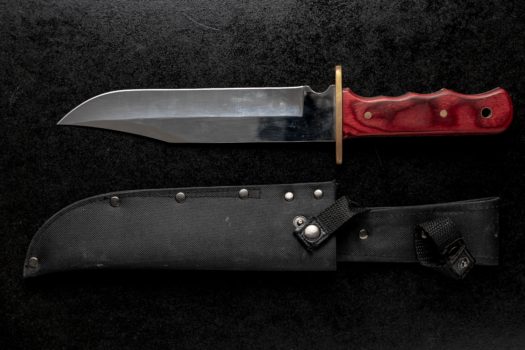
Clip Point The clip point features a concave curve near the tip, which sharpens the point for piercing tasks. Common in classic Bowie-style survival knives. The thinner tip is slightly more fragile under abuse compared to a drop point but excels at detailed work.
Tanto A tanto features a flat, angular point that concentrates force for puncturing tough materials. Less effective for slicing tasks but very strong at the tip, making it suitable for tactical use. Not the best choice for bushcraft or game processing.
For most wilderness survival applications, a drop point blade in high-carbon steel is the most practical and reliable choice.
Survival Knife Tasks Your Blade Must Handle
A good wilderness survival knife should reliably perform all of the following:
- Fire starting: Striking a ferro rod on the spine (requires a 90-degree, uncoated spine edge)
- Wood processing: Batoning through small-diameter logs for firewood or shelter poles
- Feathersticking: Shaving fine wood curls for tinder — requires a sharp, well-ground edge
- Game processing: Skinning and field dressing — requires a sharp blade with good belly
- Shelter building: Notching, splitting, and shaping wood for debris huts or lean-tos
- Food prep: Slicing, peeling, and cutting — tasks that demand edge retention
- First aid: Cutting bandages, clothing, or cordage — requires tip control
No single blade excels at every task equally, but the best survival knives come close.
Steel Hardness and Edge Retention
Steel hardness is measured on the Rockwell C scale (HRC). For survival knives:
- HRC 54–58: Softer, easier to sharpen, less edge retention
- HRC 58–62: Good balance of hardness and toughness — ideal for survival use
- HRC 62+: Very hard, holds an edge extremely well, but brittle and difficult to sharpen without diamond tools
High-carbon steels like 1095 typically fall in the HRC 56–58 range, giving them enough toughness to absorb impacts (batoning) without chipping.
Sheath Quality Matters
An overlooked element of a good wilderness survival knife is the sheath. A poor sheath that allows the blade to fall out — or worse, doesn’t retain the knife at all during climbing or scrambling — creates a safety hazard. Look for:
- Retention strap or snap to secure the handle
- Material that resists water (Kydex, ballistic nylon, or quality leather with a treatment)
- Belt loop and optional leg-tie for secure carry during active movement
Frequently Asked Questions
What is the best steel for a wilderness survival knife? 1095 high-carbon steel is widely regarded as one of the best choices for wilderness survival knives. It holds a working edge, can be sharpened with primitive methods, and produces sparks when struck against a ferro rod for fire starting. Its main drawback is susceptibility to rust, which is managed with light oiling after each use.
Should a survival knife be fixed blade or folding? Fixed blade knives are significantly stronger than folding knives and are the standard recommendation for wilderness survival. A folding knife has a mechanical joint that can fail under hard use, and the pivot becomes a weak point during heavy tasks like batoning or prying. Carry a fixed blade as your primary survival knife; a folding knife makes a useful backup.
How long should a survival knife blade be? A blade between 4 and 6 inches covers the full range of wilderness survival tasks without becoming unwieldy. Blades under 4 inches are too short for wood processing. Blades over 7 inches are difficult to control for precision work.
What is batoning and why does it matter for knife selection? Batoning is the technique of driving a knife through wood by striking the spine with a baton (a heavy stick or small log). It’s used to split firewood, process kindling, and make shelter poles. Only full tang knives with thick spines (3/16 inch or more) should be used for batoning. Partial tang or thin-spined blades can snap during this process.
Can I use a survival knife to start a fire? Yes, if the spine is uncoated and ground to a 90-degree edge. Striking this spine against a ferrocerium rod produces sparks that can ignite tinder. Many high-carbon steel knives come with spines ready for this purpose. Stainless steel knives produce fewer sparks and are less effective for this task.
What handle material is best for a survival knife? Micarta and G-10 are the top choices for survival knife handles. Both maintain grip when wet, resist cracking in cold temperatures, and hold up to years of hard use. Rubber-based handles like Kraton offer excellent grip in wet conditions but can degrade over time in extreme UV exposure.
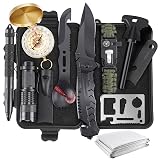
- 【13 in 1Survival Kits】The 13 in 1survival kits contains 13 essential and practical tactical gears and survival tools to meet your different needs in outdoor activities like camping hiking backpacking fishing, etc. The kit includes: survival bracelet, tactical pen, compass, tactical flashlight, flint stone & scraper, multifunctional card, 8 in 1multi-use spoon & fork, fake shrimp bait. With these professional survival gear and equipment you can enjoy a safe and easy outdoor time.
- 【Cool Gifts for Men Who Have Everything】The military grade survival kits are cool gifts for men who have everything, great birthday Christmas Valentine’s Day Anniversary Day gift ideas for dad husband boyfriend teen boys, and scouts who love outdoor adventures.
- 【High Quality Survival Kits】This is a high quality survival tool set. The tool box is made of military grade ABS material. And all the survival gears in it are made of high-quality, long lasting materials, providing excellent safety and durability. This survival kit is a perfect and reliable companion to be prepared for any emergencies. It’s an unique and thoughtful gift for dad mum family friends from daughter son.