
All products are selected by our Sharp Survivalist editors. If you buy something through our links as an Amazon Associate we earn from qualifying purchases.
Selecting the right wilderness survival tools is a discipline in prioritization. Weight and volume are limited; each tool must either perform multiple functions or address a survival need so critical it justifies its singular weight. Here is what actually belongs in your kit — and why.
The Six Survival Priorities and the Tools That Address Them
Survival instructors across disciplines organize needs into a consistent hierarchy: positive mental attitude, first aid, shelter, fire, water, and food. Every tool in your kit should map to one or more of these priorities.
1. Fixed-Blade Survival Knife
The most important tool in any survival kit. A fixed-blade knife with a full-tang construction (where the blade steel extends the full length of the handle) is structurally superior to folding knives for heavy-duty tasks. A blade length of 4–6 inches (10–15cm) handles the widest range of tasks: food preparation, shelter construction, fire preparation, cordage processing, and first aid. A convex or Scandinavian (Scandi) grind holds an edge longest in field conditions without specialized tools.
2. Ferrocerium Fire Starter
A quality ferrocerium rod (ferro rod) produces sparks at approximately 3,000°C — hot enough to ignite tinder even when damp. Unlike lighters, which fail below freezing or when fuel depletes, a ferro rod functions across temperature extremes and lasts for thousands of strikes. Pair with a metal scraper rather than your knife spine to preserve edge integrity. A 3/8″ diameter rod provides a comfortable grip under stress.
3. Paracord (550 Cord)
Type III paracord with a minimum 550 lb break strength is among the most versatile tools in a survival kit. Its internal strands (typically 7–9 individual nylon cords) can be extracted for sewing, fishing line, snare construction, and gear repair. The outer sheath handles lashing, hanging food caches, building shelters, and improvised straps. Carry a minimum of 30 meters.
4. Folding Saw
A folding saw dramatically outperforms a knife for processing wood and dramatically outperforms a hatchet in weight-to-utility ratio. A quality folding saw like the Bahco Laplander or Silky Pocket Boy cuts green and dry wood efficiently and collapses to a pocketable size. For shelter construction and firewood processing, a saw is often more practically useful than a dedicated hatchet.
5. Navigation Tools (Map + Compass)
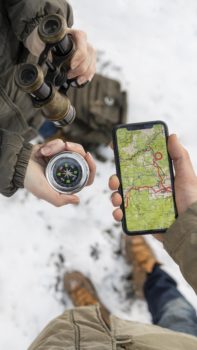
Electronic devices fail. A waterproof topographic map of your operating area and a quality baseplate compass (Silva, Suunto, or Brunton) provide infallible navigation without batteries. Learn to use them before you need them — compass navigation under stress requires practiced skill, not just equipment possession.
6. Emergency Signaling Device
A rescue whistle (Fox 40, ACR) produces a sound of 100+ decibels across extended distances without requiring breath volume that exertion-exhausted survivors can’t sustain. A signal mirror reflects sunlight visible at distances up to 16km under clear conditions. Both weigh grams and take negligible space.
7. Water Purification Tool
Addressed in detail elsewhere, but its position in the survival kit is non-negotiable. A hollow-fiber filter (Sawyer Squeeze or similar) or purification tablets represent the minimum. Iodine tablets work as a chemical backup when filters freeze.
8. First Aid Components
Compress into your kit: a CAT tourniquet, chest seals (two), hemostatic gauze (QuikClot), a triangular bandage, medical tape, and a blister kit. This covers the highest-probability field trauma scenarios without redundant weight.
Tools That Are Overrated in Wilderness Survival
Heavy multi-tools often duplicate knife and saw functions at greater weight. Hatchets are outperformed by folding saws for most firewood tasks. Flint and steel fire starting requires significantly more skill than a ferro rod for equivalent results. Military-style survival tins with toy-sized tools are adequate for pockets but not serious kit.
Frequently Asked Questions
What is the single most important wilderness survival tool? A quality fixed-blade knife. It addresses more survival priorities across more scenarios than any other single piece of equipment.
How heavy should a wilderness survival toolkit be? A comprehensive survival kit covering all six priorities can be assembled under 1.5kg (3.3 lbs). This is achievable without sacrificing capability by selecting multi-function tools and eliminating redundancies.
Do survival kits need to include food? The human body can survive 3 weeks without food. Water and shelter are dramatically higher priorities. Emergency calorie-dense food (energy bars, emergency rations) can be included, but should not come at the expense of tools addressing higher-priority survival needs.
Should survival tools be on your person or in your pack? Your ten most critical tools — knife, fire, signaling, compass, first aid essentials, water purification — should be on your person. Pack items are lost when packs are dropped, washed away, or left behind during emergency movement.
Are survival bracelets and novelty kits useful? Paracord bracelets contain usable cordage. Novelty survival kits contain tools that are too small to be practically useful under field conditions. Neither substitutes for purpose-built, quality equipment.

- [Preparedness for the Unknown]: While no one can predict when or how severe a disaster or unexpected event will be, our 262pcs survival kit helps your family stay prepared during the critical first 72 hours. Designed for family use, it was developed in collaboration with survival experts, outdoor professionals, special forces operators, and mountain guides. Whether you’re preparing for earthquakes, tornadoes, wildfires, or hurricanes, our survival kit provides peace of mind.
- [Comprehensive Emergency Supply Kit]: The included emergency supplies are stored in a bright red pouch, containing tweezers, scissors and pins, non-woven pad, triangular cotton cloth, cotton swabs, cotton balls, a generous supply of adhesive strips etc., meeting your general emergency and outdoor needs. It also includes an emergency information card to record your basic information, helping others quickly access important information when needed.
- [Safety Companion for Journey]: Our emergency kit includes many survival gear and supplies to ensure access to food, water, warmth, and light in a crisis. The fishing kit and multi-usage spoon help you catch and prepare food, while the collapsible water container bag helps store water. Fire starter and stick make it easy to build a fire. A flashlight, camping lamp, and glow sticks provide up to 72 hours of lighting, crucial for signaling for help and safe navigation.